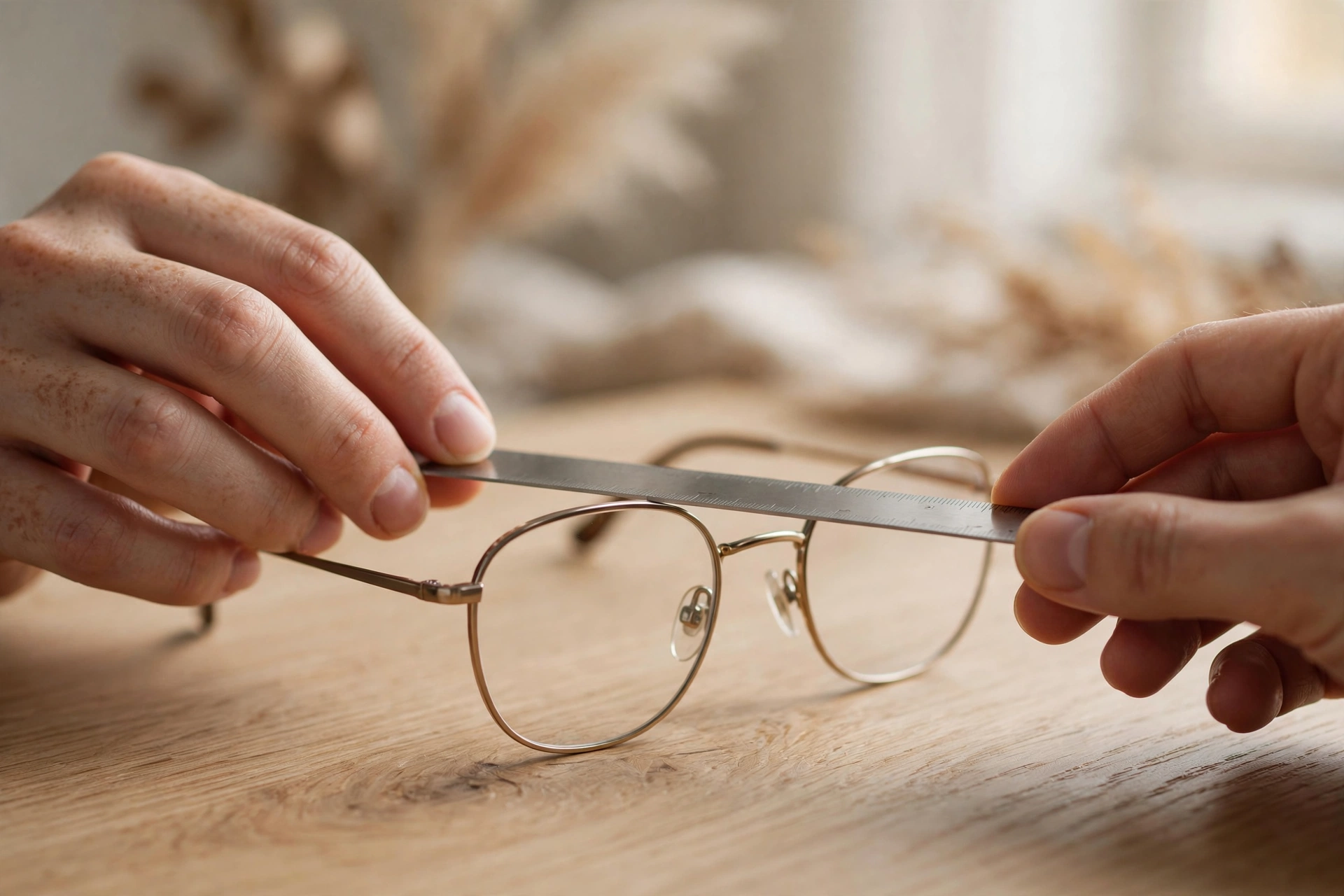
The short answer: Eyeglass frame size comes down to three numbers printed inside the temple arm — lens width, bridge width, and temple length (for example, 45-20-145). Measure your current best-fitting pair with a millimetre ruler, or use a credit card (85.6 mm wide) as a reference, and match those numbers when shopping online. No optician visit required for the frame itself.
Why millimetres beat “S / M / L”
Small, medium and large mean different things at every brand. Millimetres don’t lie: two frames labelled “medium” can differ by 6 mm in lens width, which is the difference between a perfect fit and glasses that slide down your nose all day. Learn the three numbers once, and you can buy frames online with confidence forever.
Number 1: Lens width (e.g. 45 mm)
The horizontal width of one lens, measured at its widest point. This is the number that most affects how the frame looks on your face — wider lenses suit wider faces.
How to measure it: Lay the glasses face-down. Place a ruler across the front and measure one lens from edge to edge at its widest point, in millimetres. Typical optical frames range from 44 to 54 mm.
Number 2: Bridge width (e.g. 20 mm)
The distance between the two lenses — the part that sits on your nose. Too wide and the glasses slide; too narrow and they pinch.
How to measure it: Measure the gap between the inner edges of the two lenses. Most optical frames fall between 16 and 24 mm. If your current glasses constantly slip down, your bridge is probably too wide for you.
Number 3: Temple length (e.g. 145 mm)
The length of the arm, from the hinge to the tip that goes behind your ear.
How to measure it: Straighten the arm (gently) and measure from the centre of the hinge screw to the very end of the tip. Common lengths: 135, 140, 145 and 150 mm.
The 30-second method: read your current glasses
Flip your glasses over. On the inside of the temple arm you’ll usually find something stamped like:
45 □ 20 – 145
That’s lens width □ bridge width – temple length. Write those three numbers down — they’re your personal frame size. When a product page lists its measurements (any serious online frame seller does), just compare.
No ruler? Use a credit card
A standard bank card is exactly 85.6 mm wide and 54 mm tall. Hold it against the lens: if the lens spans about half the card’s width, you’re around 43 mm; a little more than half, around 47–48 mm. It’s rough, but good enough to pick between sizes.
What fits a narrower face?
Many faces in Southeast Asia are narrower with lower nose bridges. As a rule of thumb, look for lens widths of 44–48 mm and bridge widths of 18–21 mm. Oversized 52 mm+ fashion frames might look great in photos but will feel heavy and slide on a narrower face. When in doubt, match the numbers of glasses you already own and like — your face has already voted.
3 mistakes to avoid
1. Measuring the full frame width instead of one lens. The standard is per-lens width, not the total. Mixing them up throws everything off. 2. Ignoring the bridge. People obsess over lens width and forget the bridge — then wonder why their new frames won’t stay up. 3. Confusing frame size with PD. Pupillary distance is for cutting prescription lenses, not for choosing frames. You don’t need it to buy a frame.
FAQ
What is a good frame size for a small face? Lens widths of 44–48 mm with a bridge of 18–21 mm are a safe starting range. But the most reliable guide is measuring a pair you already find comfortable.
My measurements fall between two sizes — which do I pick? Go with the smaller lens width if you prefer a neat, classic look; the larger if you like a bolder style. Keep the bridge width as close to your measured number as possible — that’s the one that affects comfort most.
Do I need my PD to buy frames online? No. PD (pupillary distance) is measured by your optician when they fit prescription lenses. For a frame-only purchase, the three frame numbers are all you need.
The numbers on my glasses have worn off. Now what? Measure them yourself with a ruler using the steps above — it takes two minutes and is just as accurate.
Measured your three numbers? Compare them against our size guide and browse The First Edit — every LINORIM frame lists its full measurements, and our support team (English / 中文) can help you pick.